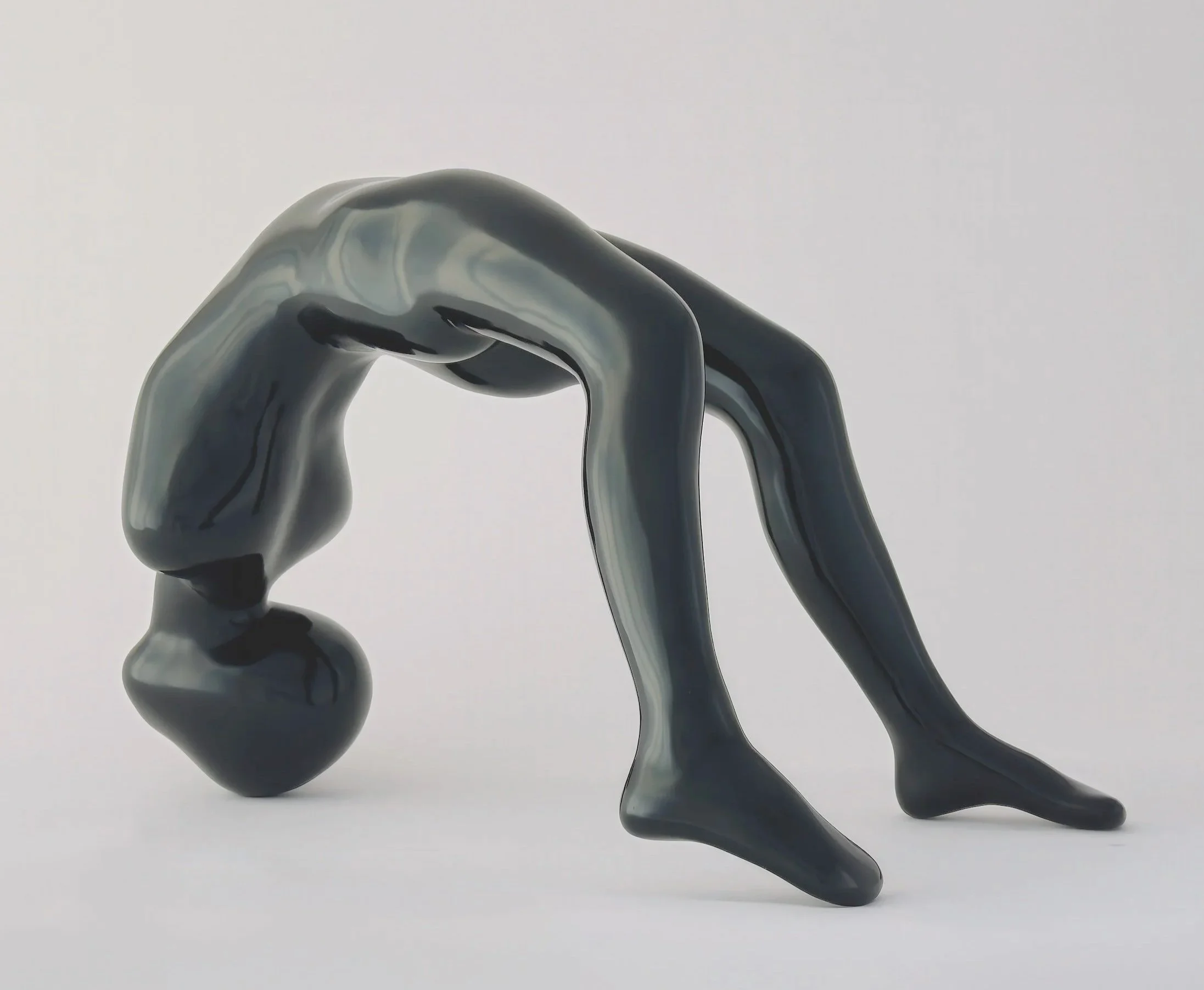
Pietà, 2026, Patinated bronze, 95 x 58 x 56 cm, Photo Martin Sjoeberg
MARIA MIESENBERGER
lessness(es)
OPENING FRIDAY 6 NOVEMBER, 12–7 PM
IN THE PRESENCE OF THE ARTIST
PART OF GALLERY WEEKEND STOCKHOLM
6 NOVEMBER – 13 DECEMBER 2026
In conjunction with the exhibition, a catalogue featuring an essay by Sven-Olov Wallenstein is published.
SWEDISH
A space between memory and action
Time traverses us; echoes and traces of the past permeate the present, setting up frames that both limit it and demand that it be brought forward. In Maria Miesenberger’s works, personal histories are fused with the necessity to move forward while still retaining a moment of disruption and unease, of being deprived of something that nevertheless insists not just on remaining, but also on making a future visible. Floating in lessness(es), where multiple times and memories are lost and regained, the sculptures are poised in a movement approaching stillness, but also seem to becatching their breath to initiate a different motion. Living on, despite everything that has come to pass, gathering strength to begin anew, they inhabit a space between memory and action, retrospection and prospective openness.
The four busts in patinated bronze – whose formal qualities range from the smooth polish of Aspiration, a blank figure waiting to have experience inscribed on its surface, to the winding lines of Contemplation, whose features can be read as imposed from outside or as emanating from some inner unrest – in various ways bring together different forms of lessnesses and restlessnesses. They can convey a sense of being shackled, with chainlike forms and their arms restrained at the back in Enduring, and yet of wanting, defiantly, to wrest themselves free. Conversely, the halo of Adaptation, reminiscent of Giotto, appears to signal expansion, transcendence, or a message from some other world that has assumed palpable form. And if there is a passing over, a going beyond, this too can in turn take on material shape. In Passage I and PassageII, the gateway to flight has taken shape as a physical structure whose empty center leaves space for those passing through.
Pietà evokes a long artistic legacy, from Albertus Pictor to Michelangelo. In Michelangelo, mourning and tenderness are woven together, but there is also a strange intermingling of times that seems to blur the age difference between the Virgin Mother and her son. Some have suggested that this derives from Michelangelo’s passion for Dante, who, in a passage in the Divine Comedy (Paradise XXXIII:1), suggests this inverted filiation by having Bernard of Clairvaux address Mary in a prayer as “Vergine madre, figlia del tuo figlio” (“Virgin mother, daughter of your son”). Miesenberger gives us two versions, Pietà (single) and Pietà (double), both of which are permeated with a similar sense of loss and bereavement, drawing on the experiences of generations bound together by muted histories. The son is no longer held in the mother’s arms, but in the first version he is placed on the ground, arched backwards so that only his head and feet touch the support; in the second, he is doubled to form a looping movement, supported only by the knees of one of the figures. In this curvature, time returns to itself, the pain begins anew in a vicious circle; and yet the sculpture radiates a strange light, the polished stainless steel reflecting the lighting as if striving to extend the athletic quality of its pose into the surrounding space. Losses are not eternal, but precisely by being given shape, they can, if not be overcome, at least become a source of movement beyond repetition.
If the sculptures with their meticulously crafted forms, evince the concentration of a long and laborious working process, Traces/Testimonies(found objects), consisting of parts of fences torn down and run over, provide a formal counterpoint by gesturing towards the contingency of form, produced by chance encounters and the disruptive power of outside forces. If fences demarcate, dividing up spaces and territories in terms of property and possession, a crumpled, demolished fence attached to a wall, “found” in its deteriorated state, speaks of a movement freed from restraints, testifying that the barriers between us, however hard and seemingly impenetrable they may appear, are meshworks, never wholly solid, and can always be torn down.
Sven-Olov Wallenstein
Maria Miesenberger (b.1965) is a Stockholm-based contemporary Swedish artist educated at Konstfack and at Parsons School of Design in New York. Her sculpture and photography use the human body to explore vulnerability and identity. With over 30 solo shows and public installations, her work is represented in major private and museum collections.
Sven-Olov Wallenstein is professor of philosophy at Södertörn University and editor-in-chief of Site Zones.